
Non-Surgical Knee Pain Solutions: Exploring Your Options Before Surgery
Knee pain can affect almost every part of daily life. Something as simple as walking through the grocery store, climbing stairs, getting out of a chair, exercising, or enjoying time with your family can become uncomfortable.
At Sole Health Medical Center, we often meet patients who are concerned that persistent knee pain automatically means surgery is in their future.
Fortunately, that is not always the case.
Many knee conditions can be managed with non-surgical approaches to joint pain, especially when the cause of the pain is properly identified and treatment begins early. The goal is not simply to temporarily cover up discomfort. A thorough evaluation can help determine what is causing the problem and which treatment options may be appropriate for the individual patient.
In this guide, we’ll look at why knee pain occurs, how it is evaluated, some of the most common non-surgical treatment options, and the role that everyday habits can play in protecting your joints.
Understanding the Knee Joint
The knee is one of the largest and most complex joints in the body.
Although we often think of it as a simple hinge that bends and straightens, the knee also performs subtle rotational and gliding movements. That combination allows us to walk, run, squat, climb stairs, exercise, and perform countless everyday activities.
The knee involves several important bones:
- The femur, or thigh bone
- The tibia, or shin bone
- The patella, commonly known as the kneecap
- The fibula, the smaller bone that runs alongside the tibia
But bones are only part of the picture.
Healthy knee movement also depends on cartilage, menisci, ligaments, tendons, muscles, and small fluid-filled sacs called bursae.
Articular cartilage covers the ends of the bones and creates a smooth surface that allows the joint to move with less friction.
The menisci are two pieces of cartilage between the femur and tibia that help absorb shock and distribute weight.
Ligaments, including the ACL, PCL, MCL, and LCL, help stabilize the knee.
Tendons connect muscles to bones and help the leg move.
Bursae provide cushioning and reduce friction between different structures around the joint.
Because the knee plays such an important role in supporting body weight and movement, repetitive stress, injuries, muscle imbalances, arthritis, and normal wear over time can all contribute to discomfort.
Common Causes of Knee Pain That May Not Require Surgery
Knee pain does not have a single cause. Two people can experience similar symptoms while having completely different underlying problems.
That is one reason an accurate evaluation is so important.
Some common causes of knee discomfort include:
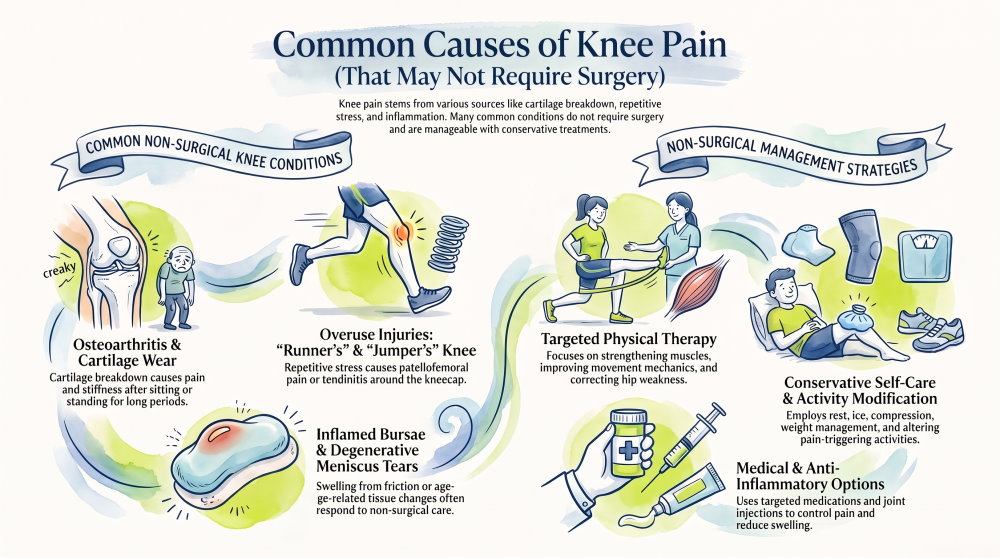
Osteoarthritis
Osteoarthritis develops as the cartilage that cushions the joint gradually deteriorates.
Patients may experience pain, stiffness, swelling, reduced mobility, or discomfort after sitting or standing for long periods.
Depending on the severity of the condition, non-surgical management may include weight management, physical therapy, medication, activity modification, or joint injections.
Patellofemoral Pain Syndrome
Often called “runner’s knee,” patellofemoral pain syndrome usually causes discomfort around or underneath the kneecap.
It can affect runners and athletes, but it can also develop in people who spend long periods sitting or whose daily activities repeatedly stress the knee.
Muscle imbalance, overuse, hip weakness, tight muscles, or improper movement patterns may contribute to the condition.
Treatment commonly focuses on physical therapy, strengthening, improving movement mechanics, and modifying activities that aggravate the knee.
Patellar or Quadriceps Tendinitis
Tendons can become irritated after repetitive activities such as running, jumping, or frequent changes in direction.
Patellar tendinitis is sometimes referred to as “jumper’s knee.”
When tendon problems become chronic, treatment may focus on strengthening exercises, rehabilitation, activity modification, and other non-surgical therapies.
Knee Bursitis
The knee contains small fluid-filled sacs called bursae that help reduce friction.
When one of these becomes inflamed, patients may experience swelling, tenderness, and discomfort, particularly when kneeling or applying pressure to the affected area.
Rest, ice, compression, anti-inflammatory treatment, and other conservative approaches may be recommended depending on the cause and severity.
Meniscal Tears and Knee Sprains
Hearing that you have a meniscus tear can sound alarming, but not every tear automatically requires surgery.
Some degenerative meniscal tears develop gradually as the tissue changes with age.
Depending on symptoms and the type of tear, physical therapy and conservative management may be considered before surgical treatment.
More serious symptoms, such as a knee that becomes physically locked and cannot fully straighten, require prompt medical evaluation.
How Knee Pain Is Evaluated
Effective treatment begins with understanding what is actually causing the pain.
At Sole Health Medical Center, the evaluation process may include several important steps.
1. Your Medical History
Your provider will first want to understand your symptoms and how they are affecting your life.
Questions may include:
When did the pain begin?
Did it start suddenly or gradually?
Was there a fall, injury, twist, or popping sensation?
Does the pain get worse when walking, running, sitting, or using stairs?
Does the knee ever lock, catch, buckle, or feel unstable?
Have you already tried medications, physical therapy, injections, or other treatments?
These details provide valuable clues about what may be causing the problem.
2. Physical Examination
A physical examination helps evaluate the structure, movement, strength, and stability of the knee.
Your provider may examine the knee for swelling, tenderness, redness, muscle weakness, or alignment problems.
Range of motion may also be evaluated to see how comfortably the knee bends and straightens.
Specific orthopedic movements and tests can help determine whether certain ligaments, tendons, cartilage, or other structures may be involved.
3. Diagnostic Imaging
In some cases, imaging may be recommended to better understand what is happening inside the joint.
X-rays can help identify changes involving the bones, joint spacing, bone spurs, and osteoarthritis.
MRI scans provide detailed images of soft tissues such as ligaments, menisci, cartilage, and tendons.
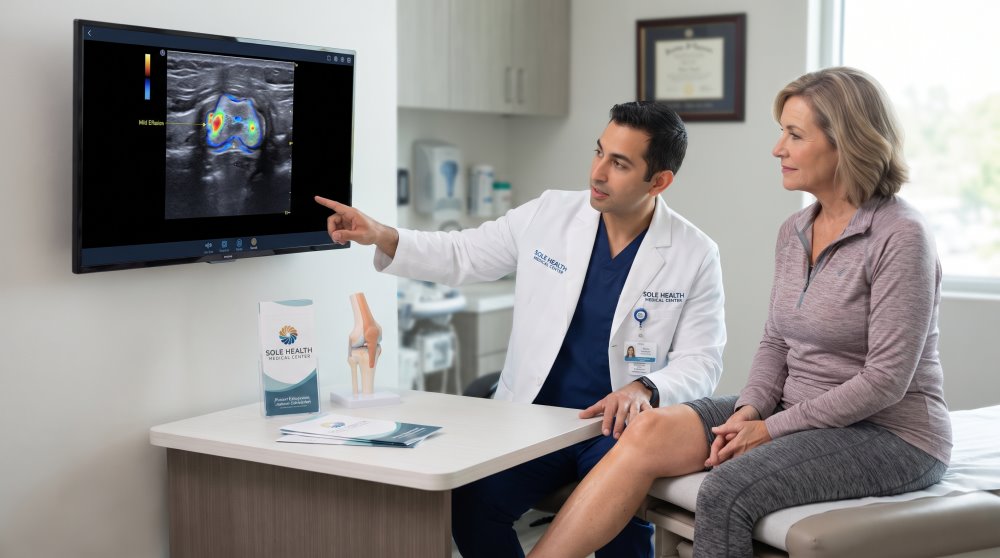
Musculoskeletal ultrasound can also be used to examine certain soft tissues and joint structures in real time.
The type of imaging needed depends on the patient’s symptoms and clinical findings.
Non-Surgical Treatment Options for Knee Pain
Once the cause of the problem has been identified, a treatment plan can be developed around the patient’s individual needs.
There is no single treatment that is appropriate for everyone.
Depending on the diagnosis, treatment may involve a combination of approaches.
Activity Modification
Avoiding every type of movement is usually not the goal.
Instead, patients may be advised to temporarily reduce activities that place excessive stress on the knee while remaining active in safer ways.
For example, high-impact activities such as running or jumping may sometimes be replaced with lower-impact activities such as swimming, cycling, or using an elliptical machine.
Some patients may also benefit from braces, orthotics, or shoe inserts designed to improve support or redistribute pressure.
Physical Therapy and Rehabilitation
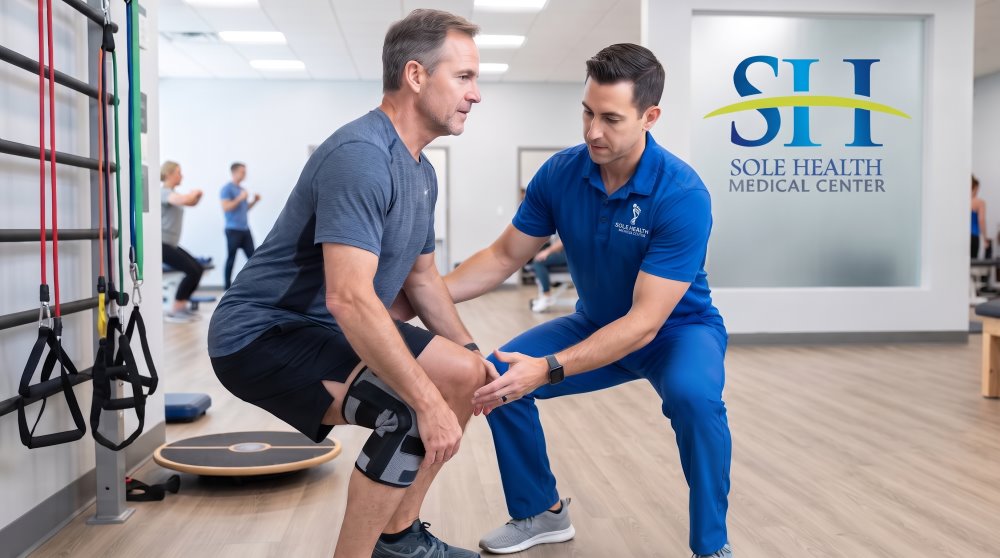
Physical therapy is an important part of many non-surgical knee treatment plans.
A rehabilitation program may address not only the knee itself but also the hips, glutes, ankles, and core.
Why?
Because the entire lower body works together.
Weakness or poor mechanics in one area can place additional stress on another.
A physical therapy program may include:
- Quadriceps strengthening
- Hip and glute strengthening
- Flexibility exercises
- Balance training
- Controlled strengthening movements
- Range-of-motion exercises
- Gait and movement retraining
The goal is to improve strength, mobility, stability, and the way forces move through the knee.
Medication
Certain medications may be used to help manage inflammation and discomfort, particularly during flare-ups.
Depending on the patient, this may include topical or oral anti-inflammatory medications.
Medication should be discussed with a healthcare professional, particularly for individuals who have cardiovascular, kidney, gastrointestinal, or other medical conditions.
Medication may help control symptoms, but it is generally only one part of a broader treatment plan.
Joint Injections
For some patients, targeted injections may be considered when conservative approaches alone do not provide enough relief.
Options described at Sole Health Medical Center include:
Corticosteroid Injections
Corticosteroid injections are designed to reduce inflammation within or around the joint.
They may be considered for certain patients experiencing significant inflammatory symptoms.
Hyaluronic Acid Injections
Also known as viscosupplementation or “gel injections,” hyaluronic acid injections are intended to supplement the joint’s natural synovial fluid.
They may be considered for some patients with knee osteoarthritis.
Platelet-Rich Plasma – PRP
PRP is a regenerative medicine approach that uses a concentrated portion of the patient’s own blood.
A small blood sample is collected and processed to concentrate platelets and growth factors before being injected into the targeted area.
At Sole Health Medical Center, PRP may be considered for certain joint or tendon conditions depending on the patient’s diagnosis and clinical evaluation.
Not every injection is appropriate for every patient. A medical assessment is necessary to determine which options may be suitable.
Advanced Non-Invasive Technologies
Some treatment plans may also incorporate non-invasive technologies.
Shockwave Therapy
Extracorporeal Shockwave Therapy, or ESWT, uses acoustic waves directed toward the targeted tissue.
It may be considered as part of treatment for certain chronic tendon conditions.
Low-Level Laser Therapy
Low-level laser therapy uses specific wavelengths of light and may be incorporated into a broader treatment program for certain musculoskeletal conditions.
The appropriate technology depends on the patient’s diagnosis and individual treatment plan.
Lifestyle and Knee Health
What happens outside the doctor’s office can be just as important as what happens during treatment.
Daily habits can have a significant effect on joint health.
Maintaining a Healthy Weight
Body weight directly affects the amount of stress placed on the knees during walking, standing, climbing stairs, and other activities.
For patients who are overweight, gradual weight reduction may help decrease the mechanical load placed on the knee.
Even modest changes can make everyday movement more comfortable for some patients while supporting overall health.
Nutrition
A balanced diet that includes vegetables, fruits, healthy fats, lean proteins, whole foods, and sources of omega-3 fatty acids can be part of an overall healthy lifestyle.
Reducing heavily processed foods, excess refined carbohydrates, and added sugars may also support broader health goals.
Nutrition should be viewed as one component of joint care rather than a replacement for appropriate medical treatment.
Staying Hydrated
Hydration is important throughout the body, including tissues involved in joint function.
Making adequate water intake part of your everyday routine supports general health and physical activity.
When Knee Pain Requires Immediate Medical Attention
Although many knee problems can be treated conservatively, there are situations where prompt medical attention is important.
Seek medical evaluation if you experience symptoms such as:
- A knee that becomes physically locked and cannot bend or straighten
- Significant instability or repeated buckling
- Inability to bear weight after an injury
- Severe swelling after trauma
- Intense redness, warmth, swelling, and fever
- Increasing numbness, tingling, or weakness
- Severe or rapidly worsening pain
These symptoms can indicate a more serious condition that needs to be evaluated promptly.
There are also situations in which surgery may eventually become an appropriate option.
If a patient has completed an appropriate course of conservative care without meaningful improvement—or if significant structural damage is present—a surgical consultation may be recommended.
The goal of non-surgical medicine should not be to avoid surgery at all costs. The goal is to determine the most appropriate treatment based on the patient’s condition.

✅ Conclusion
Living with knee pain can make you feel as though your lifestyle is slowly becoming smaller. Maybe you’ve stopped taking long walks or avoiding stairs.
Maybe you’ve given up an activity you enjoy because you’re worried about making the pain worse. But knee pain does not automatically mean you are headed for surgery. Today, patients have access to a wide range of conservative, minimally invasive, and regenerative treatment approaches that may help address pain, movement limitations, and joint function.
At Sole Health Medical Center, the first step is understanding the source of the problem.
Our clinical team takes the time to review your symptoms, examine your knee, evaluate your movement, and determine which treatment options may be appropriate for you.
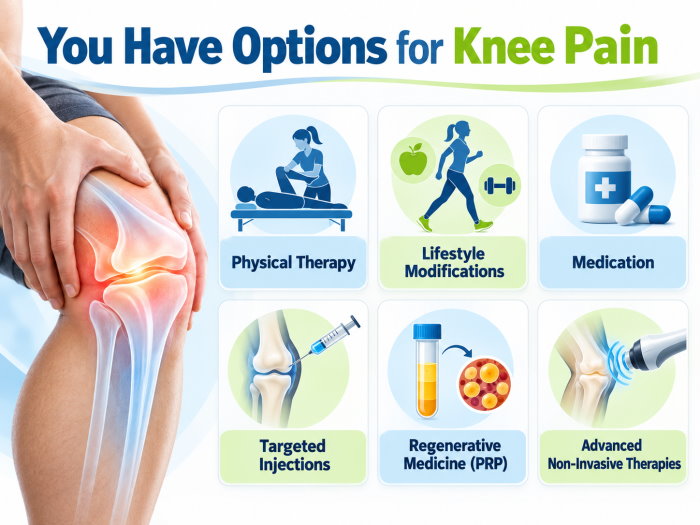
Depending on your condition, your personalized plan may include physical therapy, lifestyle modifications, medication, targeted injections, regenerative medicine options such as PRP, or advanced non-invasive therapies.
The right approach depends on your diagnosis, health history, lifestyle, symptoms, and personal goals.
If knee discomfort is interfering with your mobility or quality of life, consider scheduling a consultation with Sole Health Medical Center to learn more about your non-surgical treatment options and determine the appropriate next step for your care.

Non-Surgical Knee Pain Solutions
Jimenez2026-09-27T21:48:16+00:00August 22, 2026|Categories: Health Symptoms|Tags: health symptoms|
Non-Surgical Knee Pain Solutions: Exploring Your Options Before Surgery Knee pain can affect almost every part of [...]

Non-surgical joint pain treatments
Jimenez2026-07-28T04:09:14+00:00July 27, 2026|Categories: Health Symptoms|Tags: health symptoms|
Non-Surgical Joint Pain Treatment in Hollywood, FL - What Patients Should Know Joint pain can make everyday [...]

Why More Adults Under 50 Are Developing Chronic Health Conditions
Jimenez2026-06-25T02:23:57+00:00June 24, 2026|Categories: Health Symptoms|Tags: health symptoms|
Why More Adults Under 50 Are Developing Chronic Health Conditions—and What You Can Do About It For [...]

The Silent Symptoms You Should Never Ignore
Jimenez2026-06-25T02:21:39+00:00May 16, 2026|Categories: Health Symptoms|Tags: health symptoms|
The Silent Symptoms You Should Never Ignore: When Your Body Is Trying to Tell You Something Health [...]